

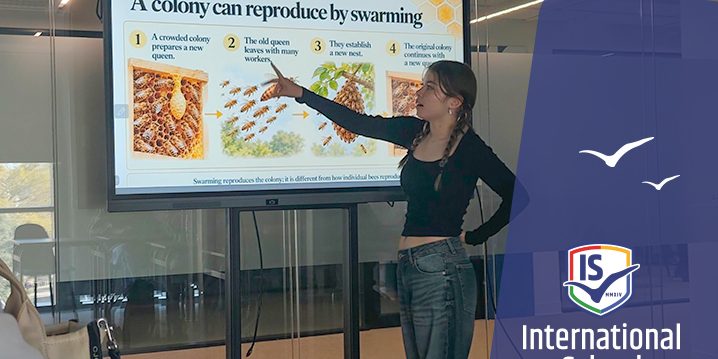
How does a single queen bee give rise to an entire colony? Our Year 11 Biology students explored this fascinating question through a project on reproduction, using the life cycle and reproductive processes of honeybees to bring scientific concepts to life.
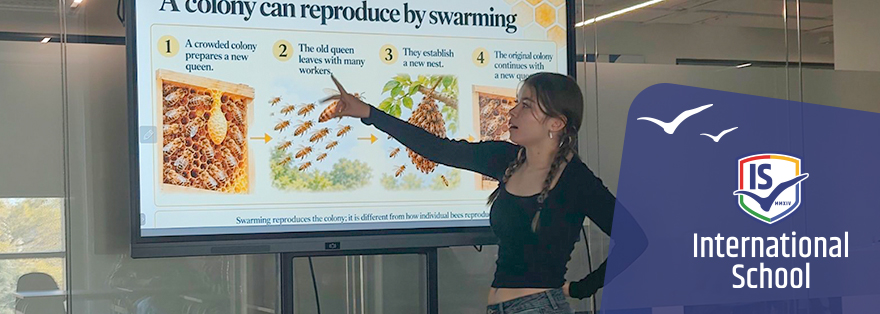
As part of their Biology studies, students investigated how honeybees reproduce, develop and maintain their colonies. Through research and presentations, they examined the differences between fertilised and unfertilised eggs, discovering how these determine whether a bee develops into a female worker or queen, or a male drone.
From Reproduction to the Life Cycle of Honeybees
The project also explored the complete metamorphosis of honeybees, from egg to larva, pupa and adult. Students explained the stages of development and the essential roles that different members of the colony play in its survival.
Another interesting aspect was swarming, the natural process through which a colony reproduces. Students explored how an existing queen leaves with a group of workers to establish a new colony, while a new queen takes over the original one.
Learning Biology Through Research and Presentation
By researching scientific information and presenting their findings, students strengthened their understanding of reproduction while developing valuable communication, analytical and presentation skills.
At International School, Biology goes beyond memorising scientific facts. Projects like this encourage students to explore biological processes, explain complex concepts and connect classroom knowledge with the natural world.