

 Snežana M. Jovičić demonstrates a strong and sustained commitment to teaching and professional development, approaching her work with notable enthusiasm and dedication. Throughout her career, she has continuously expanded and updated her expertise in biology, genetics, bioinformatics, information technologies, and modern pedagogical methods in order to enhance the quality of her teaching and research.
Her professional growth is reflected in her participation in several prestigious international academic mobility programs, including Erasmus+ at the Karolinska Institut in Sweden, CEEPUS at the University of Ljubljana in Slovenia, and the IAESTE Research Program at the Medical University of Łódź in Poland. In addition, she has undertaken specialized training in advanced computational and analytical approaches, such as the application of AdaBoost and XGBoost algorithms in biomedical research, as well as bioinformatics and big data analysis.
Her ongoing development also includes professional seminars focused on contemporary biology teaching methodologies, the use of digital tools and e-learning in science education, project-based and research-oriented learning in STEM, effective management of scientific and educational projects, and the integration of artificial intelligence tools in both teaching and research.
Contact: snezana.jovicic@iss.edu.rs
Dedication to teaching and qualifications:
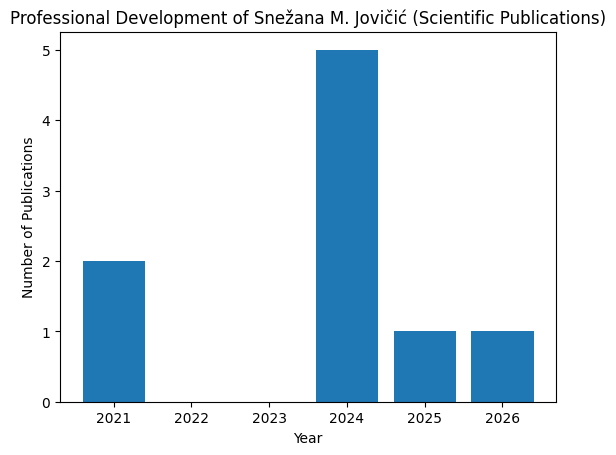
Snežana M. Jovičić is the author and co-author of papers published in high-ranking scientific journals, as well as a chapter in a scientific monograph. Selected publications include:
Journal Articles (M21a–M23)
1.Jovičić, S. M. (2025). Analysis of total RNA as a potential biomarker of Parkinson’s disease in silico. International Journal of Immunopathology and Pharmacology.
2.Jovičić, S. M. (2024). Review of contemporary fluorescence correlation spectroscopy method in diverse solution studies. Quarterly Reviews of Biophysics, 57, e13.
3.Jovičić, S. M. (2024). Analysis of total RNA as a potential biomarker of developmental neurotoxicity in silico. Health Informatics Journal.
4.Jovičić, S. M. (2024). Enzyme ChE, cholinergic therapy and molecular docking: Significant considerations and future perspectives. International Journal of Immunopathology and Pharmacology.
5.Jovičić, S. M. (2024). In silico analysis of precursor messenger RNA as a potential biomarker of myasthenia gravis thymoma. European Journal of Inflammation.
6.Jovičić, S. M. (2021). Daily water regime and sample sampling affect blood and urine parameter value change in healthy individuals. JoBAZ, 82, 31.
7.Jovičić, S. M. (2024). Uncovering novel therapeutic targets in glucose, nucleotides and lipids metabolism during cancer and neurological diseases. International Journal of Immunopathology and Pharmacology.
8.Jovičić, S. M. (2021). Global trend of clinical biomarkers of health and disease during the period (1913–2021): Systematic review and bibliometric analysis. African Journal of Urology, 27, 141.
Book Chapter
1.Jovičić, S. M. (2026). In Silico Analysis of Squamous Cell Carcinoma. In: Rezaei, N., Ziaei, H. (Eds.), Oral Immunology. Advances in Experimental Medicine and Biology, Vol. 1492. Springer, Cham.
Snežana M. Jovičić approaches teaching and professional development with great enthusiasm. Throughout her career, she has continuously enhanced her knowledge in biology, genetics, bioinformatics, information technologies, and pedagogical methods.
Her ongoing professional development includes:
- Erasmus+ Academic Mobility – Karolinska Institut, Sweden
- CEEPUS Academic Mobility – University of Ljubljana, Slovenia
- IAESTE Research Program – Medical University of Łódź, Poland
- Application of AdaBoost and XGBoost algorithms in biomedical research
- Training in bioinformatics and big data analysis
- Professional seminars in modern biology teaching methodology
- Digital tools and e-learning in science education
- Project-based and research-oriented learning in STEM education
- Management of scientific and educational projects
- Use of AI tools in teaching and research